Wednesday, April 15, 2015
Fractal Edges of the Formal System: A Case for Art
Earlier, I defined the pseudo-physical space of a game as 'the entire body of theorems that can be generated via button inputs in the formal system of the code'; but that needs elaborated on substantially so I'd like to spend some time talking about formal systems and theorems in and of gaming. The console is a computer that reads a program then outputs to the television, and each cartridge's motherboard is a formal system that generates theorems. However, "theorem" in video games can be defined in a few ways depending on one's perspective. Video games are organized upward from raw code in a meta-symbolic fashion, ultimately meaning, as I pointed out, that what we call the game exists nowhere except your mind. The programming doesn't know what the actors and situations in the game 'are' or what they 'are doing'. It just knows what to do, and that is the crux of it. Theorems of gaming exhibit a Russian-doll-like nature, and it's best to move from the outside in.
It must first be established that there is a functional difference between what sorts of states the programming can generate in the electrical circuit of the motherboard, and what sorts of states the motherboard is capable of being in with at all, given its physical characteristics and the way the computer interacts with it. I call the set of these the electrical-sate theorems - the set of all possible states of the motherboard given its physical composition and construction. This defines the glitch space to its very edges and includes anything that can be created using voltage through the cartridge in a nonstandard device, with or without visual output. As I'm sure you realize, referring to the flow of electricity through devices like this as distinct 'states' and 'theorems' is more metaphor and rhetoric than it is true information about hardware function and electrical engineering. Being made entirely out of electricity, these theorems are whizzing around at an alarming speed, and are subject to all that quantum mechanical fun-stuff that would be better explained by an actual physicist. All that is required right now is that we establish a solid language that we can populate with vocabulary useful in our attempts to describe the -meta, and these particular metaphors serve here to illustrate the notion that the programming is written on top of a more basic and essentially more capable physical medium. Consequently, our foundational language benefits when we relegate theorems to their appropriate level of origin. The flow of electricity through the cartridge serves to activate the programming, which follows its own rules. Without this component, the entire system exists in the mu state; neither on nor off.
As the game's programming follows its written procedures, it generates states which are much more concrete, so to speak. Programming can be thought of as a huge math problem that's always shifting around, with each frame (itself made up of many thousands of clock cycles), providing a distinct 'equivalency', and we can call these 'programming theorems'. Be careful to differentiate this from the logic, and derivative rules of the programming, as are not themselves theorems, merely the channels which enable the creation of theorems; as the ditch which contains water is not itself the river. And the visual frame is only representative of the actual theorem. A programming theorem in some sense also contains all the information of the mechanics, which are functional in the logic but meaningful only to us; (similar to the way the number 9 contains information about the number 3.) And although input is the means by which players interact with programming theorems, these inputs go on the supply-side of the equivalency along with game mechanics, collision detection, RNG, and other forms of procedural-type logic.
Player input has, of course, been given special priorities and powers as a variable; the only thing out of the multitude of factors going into each theorem that the player has real control over. Gameplay behavior may be able to influence further programming elements, and thus exert more overall control on the creation of theorems, but this exertion comes from a meta place and isn't actually present in the code. That is to say, the game never truly has any idea that you are tricking it. All it knows is rules and how to call for variables to plug in, hell, it doesn't even really know that you have control over any of them; the game does not know that it is being played by anyone at all.
Snip away all those sets of these programming theorems which don't necessitate or imply button input and you wind up with the game's pseudo-physical space; the entire body of theorems that can be generated via button input in the formal system of the code. However "in" the system is not entirely accurate. Indeed, for most operations of normal play, even very tricky ones, the player remains in lockstep with the generation of natural programming theorems. However, it is more correct overall to say that that pesudo-physical space also describes theorems created using the code; ie the glitch space. Not only defined by human ability, some forms of TAS and AI also operate in this domain. In fact, the goal of TAS could be chiefly summarized as explorations to map the farthest boundaries of a game's physical space, and some AIs may be pushing slightly farther still.
The rules for generating theorems are designed to be a multiple-solution puzzle. Beginning with some basic theorems the game has ready, players use their control over the button input variables to cause the generation of new theorems. None of these theorems have intrinsic worth, but some might be said to be not-valuable if they cause the elimination of player input as a variable altogether - a game over or something similar. Otherwise, it is we the humans who have given a particular meta-framework to these proceedings. We have have so designed each particular formal system to add up to programming theorems which imply narrative and mechanical structure to our intelligence. This is where the game both stops and starts existing, where it drastically changes form in the blink of a moment, as ice sublimating. This is the place where your imagination takes over.
When exploring and using glitches, you are stepping into or through the electrical-state theorems. That is, you are using your powerfully weighted input variable control to create equations that force the programming to call for some type of impossible "number", breaking its own rules by breaking the very structure of them. These electrical-state theorems are a possible configuration of the electricity running through the motherboard, which is necessarily accessible through the programming theorems but not within the set of them. Crashing Super Mario World with a cloud glitch provides an excellent demonstration of this. Remember that this 'exit' from the programming is achieved ONLY through button inputs. It's another theorem created, and it's as close as you can probably get to witnessing firsthand the imagination of a computer.
The difference between a glitch and an oversight is that glitches generate electrical-state theorems out of disparate elements of the code, and oversights merely skip between disparate programming theorems without leaving the scope of them. My own infinite shell trick exploits not a glitch but an oversight. Oversights are loopholes and glitches are wormholes. We step out of the realm of what is supposed to happen into the realm of what can happen in order to achieve this or that. Sometimes it just happens.
But about this notion of programming theorems having no intrinsic worth; well, they don't unless we turn on our meta-framework. What this means is that we accept the game as a real space, and shift our focus to the in-game details. You know, play the game. When we do this we're suspending our knowledge of the game being drawn as a single evolving state, and discussing in detail the subroutines that put stresses on button inputs. As humans, we are woefully slow. Even a very quick tap to a button can seem like eternity to a computer. From the console's point of view, the game we're playing is happening painfully slowly. Thus we realize that programming theorems are moving by much to fast for us to exist inside just one. Sometimes this is possible when the game freezes or has limited elements, but generally we are moving through strings of theorems at sixty or more per second. What makes sense then, is to isolate bits of programming which have special relevance to our 'real' game and create one more smaller class of theorems for them - game theorems. Score and level number are the two most obvious examples, but there are many others. You can turn whatever you want into a game theorem by adjusting your perspective of the meta-game. That is to say sure, you could play the game as intended, but your rules are just as relevant and real and generative as theirs because all systems of meta-games are merely superimposed over the player input / theorem generation loop. The picture now becomes complete; the game of button input is to direct the programming theorems into producing a desired game theorem.
In short, and I must make this incredibly clear, in a loud, bold declaration - game theorems are things which players CREATE! This is so essential. Playing video games is a generative art which does result in real things. Admittedly fluid and vapor-like things (as music can be shown to be real air molecules vibrating, etc), but they are real nonetheless. You have caused the electrical-state theorems to be arranged in a distinct and specific way - you are sculpting with electricity Accessing these theorems requires thousands of individual button inputs executed with proper enough timing, as a large model building can be built from individual toothpicks; as a rock carved with thousands of well-articulated chisel strikes. Each strike is important, and adds up to a greater whole which no longer contains them. The demands imposed on button pressing skill force the creation of a sufficiently complex, cohesive, and adaptable system of techniques. This is why I say video gameplay is art. You are taking a medium and arranging it using skill to produce a tangible result. It's just that in this case, electricity is the medium. So fragile and thin, you have it for a moment...as long as you'd like before the power goes out, electrons held in suspension, placed there by your will and your energy alone.
It's a neat feeling.

Wednesday, April 1, 2015
Atari the Haiku of Games
Atari the Haiku of games
as with the haiku
stress of limited form
places all focus on core structure
the response is immediate, felt
in a puff of dissonance and harmony
Deep or wide
funny or incorrect
it is there to be counted and assumed
Existing and extrapolated in synaptic pulse
An electron-cardboard diorama of the Void
from a palm-sized rectangle of space
Sunday, March 1, 2015
All sound, as now
Clutter and solitude in the early
spaces white
and blue and silk paint.
and blue and silk paint.
The smells irreflexive and felt, as
unobstructed
The swoosh of the neighbor's dog
or
the snare spackle bathwater hiss in the rain drain.
When more various sound
went to the word place
of the pre-hardwired brain.
the snare spackle bathwater hiss in the rain drain.
When more various sound
went to the word place
of the pre-hardwired brain.
Ominous / amiable fractal possibility
so-forth character pickup.
Exchange lesson with the content of what is
made possible by no interpretative / context faculties.
After growth, built backwards downwards and inwards from the first
Encrypted in the syntax of memories
the reception of physical language taking place,
as now
Wearing the skin of elegant, phaneronic symmetry.
Thursday, February 26, 2015
Controller Articulation as the Source of Felt Kinetics in Video Games: An Introduction
Gameplay begins with the realization that there is no game. That which we might point to as 'the game' is merely programming that instructs an electron gun inside a CRT monitor to fire particular sequences, which are in turn affected by opening or closing little switches with your fingers, i.e. the buttons of the controller. Nothing more. In fact, the console doesn't even care if the television is on or not. It's perfectly content to run the game in that mysterious, deep darkness where computers dream. The game exists in your head, it is you giving meaning and direction to the things which are happening. This is a world of arbitrary symbols coupled with representations of physical rules that can be spoken to by wiggling your thumbs around. Video gameplay is not, at its core, visual, although a high degree of acuity is indeed demanded by the practice in many regards. As one reads the words of a novel, one reads the programming; and in much the same way as a musical instrument is played or a trick of stage magic performed, the video game is played masterfully through sleight of hand.
This is an attempt to establish a vocabulary for video game playing techniques, as well as a means of perceiving video games as fundamentally tactile. Ideas about in-game elements like strategy and secrets exist in a separate sphere. This is not really a how-to, nor is it an attempt to over-complicate things. If this all sounds familiar to you then good, we're all getting somewhere. These are discussions that didn't exist and I wanted them to so I made them. Stop me if you've heard this one. Go ahead and call this a series of personal essays. In this first bit, I endeavor to explain the pseudo-physical reality of video games, the perception of control objects as real, and input duration as the source of felt pseudo-kinetics. That's a wonderful foundation from which to talk about meatier things. As well, I hope to establish some definitions that will come in handy later. It's also good to keep in mind that notions about 'what the programmers intended' have no place here currently.
In what is, essentially, the frame-by-frame flip-book of the game, depth of physical experience is simulated with motion and collision of images, supplemented by audio; indeed there is no other way. We are interpreting our control image on the screen as a 'symbolic player', but it is important to remember that the program is always drawing the entire screen as a single unit with interacting meta-parts. (All symbolic players are made of the code, and thus intrinsically tied to each other no matter their perceived degree of separation.) In this same manner of interpretation, we must also realize that we are within what can be referred to as 'symbolic laws of physics'; designed only to mimic what we see in the world or, in other cases, thwart and mock it. These symbolic laws come in varying degrees of rigidity, and are mostly supported by visual illusions - i.e. walking into a solid may only give the illusion that it is truly solid. The pseudo-physical space of the game describes the entire body of theorems that can be generated via button inputs in the formal system of the code - all that is possible. The pseudo-kinetic space loosely refers to those particular theorems that are useful to gameplay, so called 'physical moves' - all that is practical. This having been established, it now becomes convenient to drop the prefix pseudo- when referring to the physical environment inside the game; it is implied.
The kinetics of player control are felt and described by the duration of button inputs, and I refer to this principal broadly as 'articulation'. Naturally, the shortest duration of input is a single frame, possibly less, and indeed a discrete number of frames could describe any input. For our purposes currently, it is not necessary to slice things up so precisely. What is important, is to think about duration in the physical act of pressing the buttons. Consider that there are, in fact, infinitely many ways to press a button.
Three main lexicons of controller articulation, listed hierarchically, are: squeeze, tap, and roll. These are simply ways of holding the controller and pressing the buttons. Proper tactile gaming begins with hand placement on the controller, but since this is different for everyone, there is actually no 'proper' way. Use this vocabulary as a jumping off point for creating your own style, not guide to copy. 'Squeeze' is the largest and most common technique; involving keeping constant contact between one's fingers and the the buttons. 'Tap' is mostly self-explanatory. 'Roll' refers to the larger ramifications of the classic 'double flap' technique, involving rolling one's fingers across a single button to tap extraordinarily fast. It is important to use the correct technique for the situation. By maintaining constant contact with the buttons, tighter control over the input duration is achieved. When jabbing at the buttons, or through sloppy hand control, inconsistencies and delays begin to occur. Practice by getting a very good sense of how far down the buttons on the controller press. Really understand how much pressure you're applying with your thumb. Squeeze a button, release without letting go, then try to squeeze it for exactly half that long; twice that long. Tap at different frequencies, with different fingers. Relax and maintain constant contact; the squeeze motions you make to depress a button reverberate throughout the entire plastic body of the controller and are felt everywhere in the hands.
The 'jump' mechanic is an easy and familiar example. The maximum height of a jump can be explored in two ways simultaneously - visually, and manually. With your eyes, you are judging relative distance on the screen. With your hands, you are establishing the particular articulation required for that jump. It is of critical importance that these relationships be felt, not merely perceived. Imagine the control object is real, and scan it for properties such as weight, friction, and momentum. This is a thought experiment that helps give meaning to the feeling of particular squeezes. A heavy jump will feel heavy in the way the button gets pressed. A large amount of friction can be felt in the responsiveness of the d-pad. Musical ideas such as 'beat' and 'tempo' apply to button articulation as well, because input durations exist in solid and explore-able relationships to each other. Cut the height of a jump by cutting the input duration. You will not have time to think about it, the player must be able to feel the difference naturally.
There is a particular time signature in each game that must be played with the hands and not the eyes. It is not unlike playing a musical instrument. Each note has both a pitch and duration, and rhythm is the essential structural form. The guts of mental training for video games involves being able to separate and recombine the actions of one's eyes and hands, and thereby discover and explore a deep, meditative type of zen. To move before the eyes see and see the way the hands move. The ultimate practice is to develop muscle memory nuanced enough to adapt to increasing degrees of subtlety demanded by either the game itself or the meta-game currently in effect.
But I think that's enough to chew on for tonight.
Tuesday, February 24, 2015
Cartridge Review: Masters of the Universe - The Power of He Man
Before this review can begin, I need to establish my level of nostalgic connection with the He Man franchise - it is zero. I grew up with early 1990's Nickelodeon cartoons, and when I wanted fights and transformations, I turned to the VR Troopers and their derivative action figures. I don't even think I could identify He Man until I became an adult; and as such, I won't be spending any time considering how much of a resemblance this game bears to the realm of Eternia. It is slightly above zero, as far as I can surmise. I hear the collective groan from the hardcore fan base, but remain politely unapologetic for my ignorance of all things He Man. It should be a given that it's more or less impossible to accurately recreate shows or movies as a 4K game program anyhow.
 |
| Go beat the game to see the other image. |
M-Network's 'Masters of the Universe - the Power of He Man' for Atari 2600 had three graphics programmers, two regular programmers, and one for sound; which might explain why the game feels like an asymmetrical mash up of too many ideas happening at once. One thing that was definitely agreed upon is the fact that a lot of space was to be given to the opening title screen, which features a little animation of Prince Adam transforming into He Man and a weird little boop-y song with unsatisfactory melodic resolution. (The cartoon theme?) Considerable resources are also spent on the flashing image displayed upon clearing the second level and beating the game. These folks are trying to sell an Atari game based on a cartoon character after all, and these graphics are pretty good for the format.
Far less time and energy seems to have been spent on the actual gameplay, however. They could have started with a simpler basic premise, but instead created an overzealous mix of elements that constantly gets in its own way. Somehow though, this bumbling game becomes a horribly awesome freak-out of a thing. Like an episode of Mystery Science Theater 3000, the crummy gameplay is endearingly, frustratingly, awful. On B difficulty, (loops 3-8+) it's just frustratingly awful and might also trigger nauseous seizures. Actually, it might do that any time.
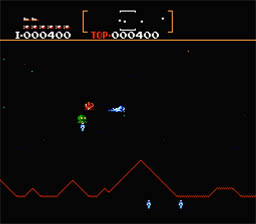
Naturally, the narrative centers around you riding your hover glider thing to Castle Greyskull and defeating Skeletor. The gangly mash up begins here, because the 2 levels in this game play entirely differently. It's as if nobody could agree or even compromise about how this game should operate. Starting above a home base square, the screen is laid out quite a bit like Defender. You can fly your ship left and right and the screen scrolls in that direction. You can move up and down, too. Some little numbers and an arrow indicate distance from the castle, and you start 30 units away. Either direction will get you there, which seems to indicate that the planet is incredibly small, or that you're moving in some kind of doughnut-shaped 2-dimensional space, but regardless; you also have bombs and lasers. Well, sort of. Since there's only one button to press, you get one or the other. If there's a spinning doodad on the screen, you shoot lasers. If not, you're droppin' bombs, and you must be above a certain height to do so. As we'll see, this is one of the things that makes gameplay so bad - the fact that you need mutually exclusive weapons at the same time.
Your way to the castle is blocked by enemies on the ground that act like little magnets. They stick to one spot, scrolling onscreen with your movement. Fly over one, and they jostle you around horizontally with no escaping. That's a pain the the ass already, but these jerks do two other things: launch a little spinning doodad, and shoot a tiny square upward; both of which kill you. Your bombs create black holes in the ground, and that's the only way to get rid of them. The spinners they launch will immediately fly toward you with staggered pauses. They can only be killed with a laser shot directly to their center; the old Atari gameplay paradigm of being able to hit a pixel with a scanline. It doesn't help at all that your lasers have very short range, slightly more than one body length. Rapid fire on / off is controlled via the color switch on the console.
 |
What was supposed to be a vertical / horizontal dogfight of sorts becomes only a horrid chore. If you don't destroy a magnet immediately with a bomb, it will launch a spinner which prevents you from dropping bombs until you destroy it. Now you're stuck over top of an enemy that can kill you with an upward shot, lacking any way to defend yourself on the vertical axis. You're being jostled around horizontally which affects the scroll of space, bringing the spinner which is already tracking you right into your head in just a few incomprehensible seconds. If you destroy the spinner, the magnet will launch another with very short delay, allowing you to get off only a few bomb shots before another spinner fight. You can't move on until you destroy the magnet and even if you do move on, the next enemy will just be another magnet. If you get hit, the game freezes and flashes horrifying colors but doesn't re-set the board in any way; the enemies left onscreen stay there. When you regain control after a death freeze, you can just get hit again right off the bat, and suck up all 3 of your lives immediately. Oh, but, good news! You can go back to home base and buy more lives for 100 x loop# points a pop. Except you can only carry 3. And no, zero doesn't count as one.
The bizarre physics happening in the screen scroll is both the main reason why gameplay is so broken, and the point of leverage against it; as many situations like this are. We'll get to Castle Greyskull in a second, hang in there.
 |
| Hang in there, get it? |

The best way to deal with the magnets is to destroy them with bombs before they have a chance to launch a spinner. The game seems to want you to do this by flying above them, after all, their upward shot is destroyed by bombs as well. Yet, this really just leads to a lot of gruesome death because the spinners launch so quickly. A better way to destroy them is by manipulating the weird scroll. When your bombs fall, they create black holes on the ground, which are then part of the landscape, or space; meaning they now scroll faster than objects. What you can do, is create a crater to the side of a magnet, then reverse direction. We would expect the hole in the ground and the magnet, both on fixed positions in the ground, to remain at equal distance from each other at all times. What we find instead is that, since the magnet is scrolling more slowly than the hole, the hole can simply be moved underneath the magnet, and poof, it's gone. You're safe for another few seconds. This principal also contributes to the frustrating nature of the spinner fights - during your window of opportunity to bomb the magnet, the holes you create are always sliding out of their intended locations. It's quite possible to create a hole in the extreme left side of the screen, then slide it under a magnet on the right. In so doing, you limit the number of dog fights you must engage in and eventually reach Castle Greyskull.
This level is much more straightforward and, um, "enjoyable". Skeletor is chillin' out on the right side of the room shooting lasers at a specific frequency, and you can block them with your sword button. Just run to the right and touch him. That's it. Wait, this level also has the most amazing colored, moving walls I've ever seen on Atari. In the same vein as Laser Gates and Yar's Revenge, these barriers are the true graphical miracle of this game; squares within squares that constantly morph into each other while the walls move back and forth. Things get even cooler when you touch a wall or get shot; the screen has a massive spasm of color and you must start back on the left, temporarily slowed down. What's more, you can't really die. Not unless your score hits zero. Every hit just removes some points, and if you've made it this far you should have plenty. Enough to have some fun running into things. Just you and Skeletor, two stupidly immortal cartoon-based video game characters kicking back to enjoy a face-melting disco trip. When you get bored or start throwing up, just end the level to hear that weird little song again and loop the game.
 |
| Fuck it, I've got points to spend. |
Apparently, the difficulty will continue to increase until the 8th loop, but I can't bring myself to play that long. The best score I managed to get while researching for this article was 40K. Speed increases right away on loop two, and magnets on the first screen launch spinners almost immediately, dragging you into death traps all the time. If you make it to Skeletor again, he'll be firing even more lasers at a quicker frequency. It might be interesting to see if racking up a huge score by remaining on one screen would cause the programming to glitch out or crash. If so, we can only hope the resulting break in reality would engulf all of Eternia in a tie-dye acid wave with a static soundtrack. The colors are the only thing that can save us from the crap-fest that is this game.
Monday, February 23, 2015
Whats it Like
You can't stop noticing and haven't
thought to notice.
Though you notice much.
Even it.
Even it.
The very intense world hears you listening
And listens back.
Tongues of inflection speak into existence visualizations of concepts
Tying spiderweb into diffusions of light
On the water surface of the form nameable.
But how can you tell the others?
With no such life machine symbionts.
Evaporating branches of possible minds fog out
The archetypes introduce themselves.
Microscope insight reveals macrocosm tendencies.
It's like paralyzing and raw-egg sweet.
You and your fractals of ambivalence, and they stop motion time.
Subscribe to:
Posts (Atom)